“Wuthering Heights was hewn in a wild workshop, with simple tools, out of homely materials. The statuary found a granite block on a solitary moor: gazing thereon, he saw how from the crag might be elicited a head, savage, swart, sinister; a form molded with at least one element of grandeur—power…With time and labor, the crag took human shape; and there it stands colossal, dark, and frowning, half statue, half rock: in the former sense, terrible and goblin-like; in the latter, almost beautiful, for its coloring is of mellow grey, and moorland moss clothes it; and heath, with its blooming bells and balmy fragrance, grows faithfully close to the giant’s foot.” –Currer Bell (Charlotte Brontë)
Emily Brontë and her sisters lived surrounded by the amorality of Nature: the pitiless storms and bright flowers, the early deaths and flashes of joy evinced no Christian system of reward and punishment. Brontë’s only novel, Wuthering Heights, begins and ends with ghosts: a desperate waif rattling the window of a house of horrors and lovers haunting the moors long after death. The ferocity of Cathy and Heathcliff’s passion and the pain they inflict on each other and everyone else are mirrors of both Nature’s ruthless indifference and humanity’s immoral acts: the cruelty perpetrated by characters includes physical and psychological abuse, betrayal, humiliation, animal mistreatment, and not once, but twice, the digging up of a corpse.
Heathcliff, the “dark, “swarthy,” “gipsy brat” snatched from the streets of Liverpool and brought back to the house on the moors is the maligned outsider whose intense connection to Cathy is forged in shared trauma. Like Lord Byron, Heathcliff is “mad, bad, and dangerous to know”; unlike Byron, he takes no solace in poetry; his is instead an anti-intellectual alignment with the forces of wind, rain, and darkness. Spurned by Cathy, who chooses the “civilized” luxuries of class and money symbolized by the blonde, blue-eyed Linton family of Thrushcross Grange, Heathcliff’s sole motivation is revenge.
The force of Cathy and Heathcliff’s attachment cannot be muffled by layers of narrative. The first-person narrator is the foolish Lockwood, and the bulk of the story is told to him by the manipulative, often spiteful servant, Nelly. These pedestrian observers (and in Nelly’s case, occasional meddler) pale in comparison to the “fierce, pitiless, wolfish man” (as Cathy calls Heathcliff) and the wild, “half-savage” teenager who claims that her love for him “resembles the eternal rocks beneath—a source of little visible delight, but necessary.”
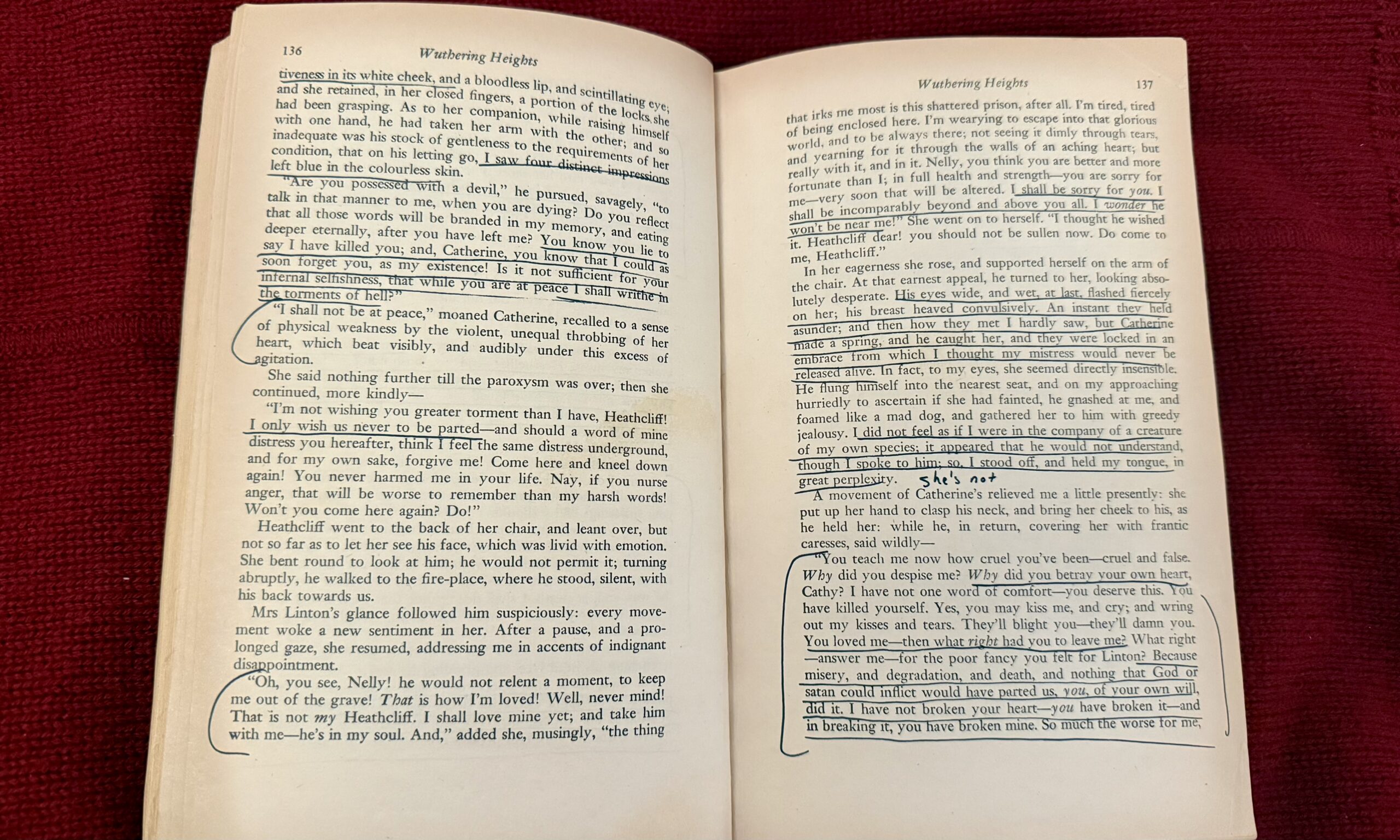
In marrying Linton, Cathy has chosen comfort and safety over her own heart, and in doing so, has assured mutual destruction with collateral damage. When Heathcliff returns from self-exile, outwardly urbane, his purpose is to claim the property, riches, and family of his tormenter, Cathy’s brother, Hindley. When, halfway through the novel, Cathy dies in childbirth, Heathcliff has no patience with Nelly’s sanctimonious claim that Cathy is in heaven: “May she wake in torment!…Catherine Earnshaw, may you not rest, as long as I am living!…haunt me then!…Be with me always—take any form—drive me mad! Only do not leave me in this abyss where I cannot find you! Oh God! It is unutterable! I cannot live without my life! I cannot live without my soul!”
Just as when I first read these words as a teenager myself and thrilled to Catherine’s impassioned cry, “Nelly, I am Heathcliff,” I am still deeply moved by the fervor of “he’s more myself than I am. Whatever our souls are made of, his and mine are the same.” Their souls are hewn from that granite block as is the book itself, more Pagan than Christian, more Gothic Romantic than romantic, more madness than love. I’ll never forget turning out all the lights, closing the door, and playing Kate Bush’s eerie, otherworldly song on cassette for my class of tenth grade students.
Nobody is writing songs (or making movies) about the younger generation in the second half of Wuthering Heights, but I would argue that this is where the true romance lives. Cathy’s daughter, Catherine; Hindley’s son, Hareton, and Heathcliff’s son, Linton, are miserable pawns in Heathcliff’s violent revenge game. This Catherine is spirited but stable: “her anger never furious; her love never fierce [but] deep and tender”; Hareton, uneducated and warped by Heathcliff’s neglect, is also “honest, warm, and intelligent”: the two of them escape Heathcliff’s machinations when Catherine teaches Hareton to read. Bent over books together, but also sharing the desire to cultivate a garden, these young lovers represent the blooming heath next to the “giant’s foot,” the gentle, joyous best of both worlds.
However, Wuthering Heights doesn’t end with gardens or Nelly and Lockwood’s insistence that the dead sleep in peace. “How,” Lockwood muses, at Heathcliff and Cathy’s graves, “[could] anyone…ever imagine unquiet slumbers, for the sleepers in that quiet earth.” We don’t just imagine it; we know it: Heaven or Hell could never hold them; their fierce attachment is to what is elemental in each other, to their tempestuous natures reflected in the stormy moors of their childhood. For almost 180 years, readers have been haunted by the brutal beauty carved from Emily Brontë’s “wild workshop”; like the old man and the boy in the last pages, we see the ghosts of Cathy and Heathcliff, together at last, wandering in the misty rain.