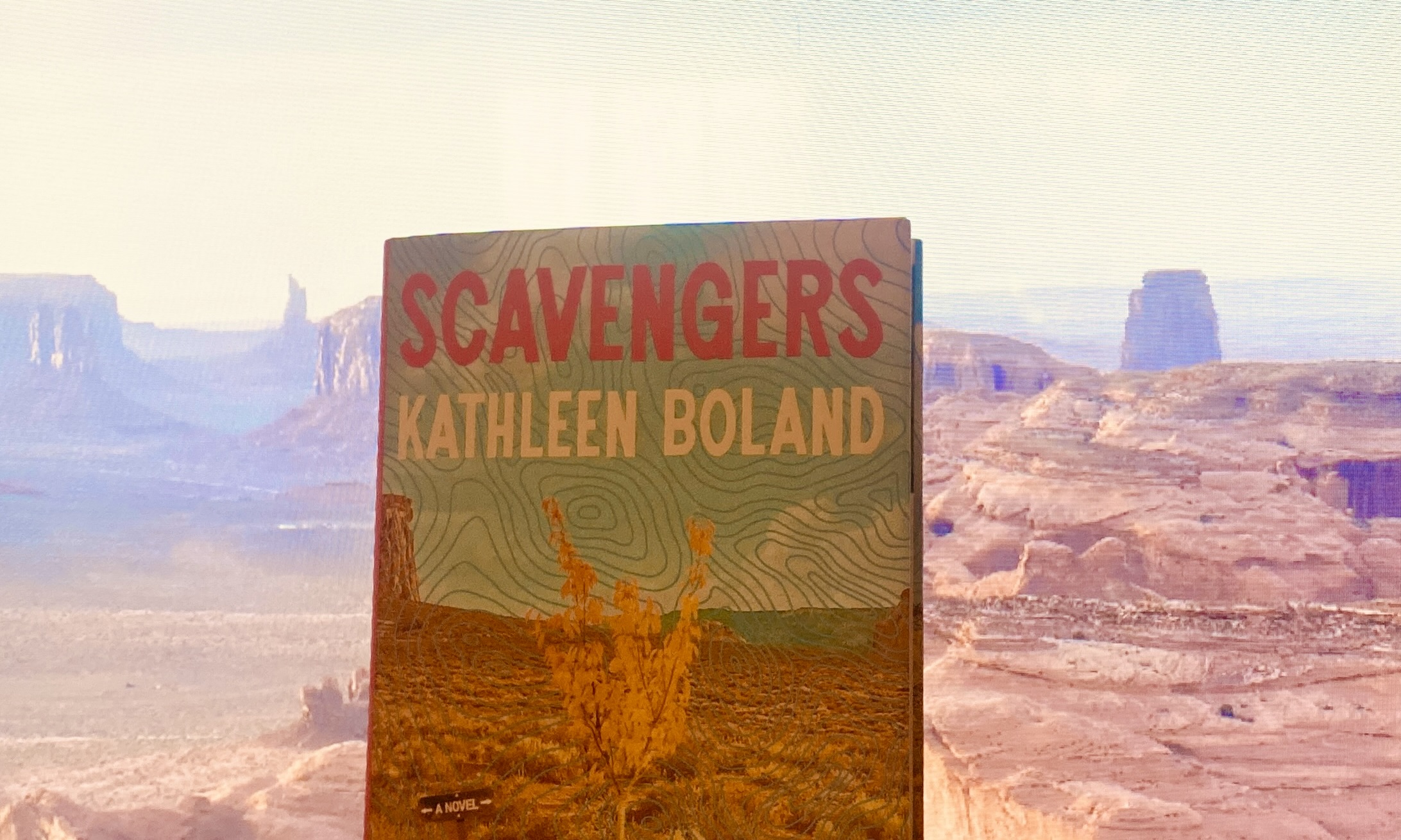
Kismet drew me to debut author Kathleen Boland’s novel, Scavengers, for my Sundance Film Festival read. Every day of my trip out west, I emerged bleary-eyed from another documentary to dive back into the story of a mother/daughter duo on a wild journey through the formidable Utah desert.
Thirty-something Bea Maron is a mess, but not one of those adorable, noisy messes you find in romcoms. Bea is the kind of quiet mess still in recovery from a very weird childhood. Poor, risk-averse Bea is chasing stability, though it eludes her at every turn. As the novel takes off, she is fired from her commodities-trading job after a disastrous weather prediction (yes, that is apparently a thing). She spends her days on a fruitless job hunt and compounds her misery by scrolling through images of the growing romance between her situationship and a college roommate who always made her feel like hired help. As her prospects dwindle in New York, Bea buys a one-way ticket to Salt Lake City with a half-baked plan to ride out her employment drought in the desert, letting her peripatetic mother, Christy, take care of her for once.
Fat chance of that, though. Christy’s whole life has been improvisation on a high wire, leaping from men to women to get-rich-quick schemes, the latest of which has brought her out west. In fact, Bea learns with horror that her mother has moved to Utah to partake in a fool’s gold treasure hunt. Apparently, an internet poet has hidden one million dollars somewhere out west, and Christy’s parsing of his poem has led her to believe that it’s not far from Salt Lake, hers for the taking. Christy’s partner in the hunt is a dubious online pal named Bob, and when they agree to search a remote canyon together, Bea’s alarm bells go off. She insists on accompanying her mother on what will no doubt be a wild goose chase.
The novel really takes off as the pair heads into the Utah desert: there are perilous hikes and languid nights, both filled with endless drinks, cigarettes, and other bad decisions. There’s even a prospective romantic partner who would have never been on Bea’s wish list back in New York. Boland deftly shows us how the remote and otherworldly landscape changes Bea’s internal landscape as well: “The city could make you feel small in a million ways, but it was mostly because of other people, because of things they did and demanded. Here, you were dwarfed by something much bigger and more powerful, intangible and merciless. She took a picture. It looked nothing like what was outside the window. She’d never be able to capture this.”
Scavengers knows just what kind of ride we’re all on here, and it’s really fun to watch Bea drop the corporate clone act and let a bit of her mother’s DNA shine through. Christy’s wrong about a lot of things, but not about Bea’s need to fill her life with possibilities instead of predictions. There is always a frisson of true canniness shining through the layers of Christy’s naiveté and self-absorption, leading Bea to realize that underestimating her mother isn’t a bet worth taking.
Twists of every variety bubble up like a desert hot spring in this clever, quirky tale, right until the very end. Yet the most interesting discoveries in Scavengers aren’t found on any carefully constructed treasure map. They’re the mysteries of love and family that create a journey to spin us all in new, unexpected directions.