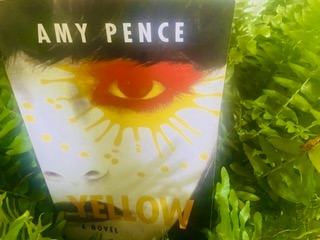
In her second collection of poetry, Armor, Armour, Amy Pence’s poem, “Global Positioning Systems,” reads, in its entirety: “Souls glide past the earth’s/fierce and mythic wreckage,/Stupidly, the eye regards/what is lost.”
Pence’s artistry melds the everyday and the infinite, always with a dash of wonder. Yellow is the prolific poet’s debut novel, imbued with the poem’s theme of trauma’s journey through time and space. Eliza, or Z, is a young girl whose life is forever marked by the phantasmagorical, cascading slime she encounters in her backyard and names Yellow. Again and again, Yellow visits Z , like a form of divine consciousness, a veritable angel. Z is haunted as well as blessed, but by a far more hazardous danger than a sentient, sprawling blob. The truly terrifying creature who traumatizes Z is–surprise, surprise–a man.
Fortunately, good men who give Z love and inspiration also populate her story. There is Aakash, the beloved who steals her heart from a continent away. There is her loving, complicated sibling, Clem, who shares her passion for soul-searching. There is even a warmly fictionalized depiction of astronaut Pete Conrad, the commander of Skylab 2 and the third man to walk on the moon. Tying them all together? The real and metaphysical tendrils of Yellow. In one of the many glimpses of Pete Conrad, performing ordinary tasks in the most extraordinary setting, we get this omniscient narration of the look towards home:
“From space, the earth is neither a timeline or a points system. It’s not a map or a bitter wafer on the tongue. From space, the Earth has no marketing plan or agenda, no electorate, no street sign, no huddled masses yearning to be free…The oceans carry every shade of blue’s infinity. Clouds pink and susurrate like oceans; they soothe and bottom into canyons. The Earth is but a remembrance and a forgetting.” Here, the novelist sticks the landing of her theme, and the poet is also given air time.
Yellow travels in a singular way through time, linking these character’s stories with our own. We march through decades of America’s intermittent exceptionalism, our time-worn pattern of lurching forward triumphantly, only to scuttle backward, bewildered and ashamed. The Skylab space journey, Watergate, Hurricane Katrina, and Covid-19—again and again we are reminded that Z’s journey is in a flow with multitudes. Creative Z eventually molds her experiences into exhibits that turn trauma into art. Yet Yellow is not simply a portrait of the artist as a young victim or young survivor, though she is both. More than a touch of magic stretches and spreads across these pages, leaving an incandescent mark. This is a psychic scrapbook of a novel, the primary tale interrupted with timelines, news accounts, and philosophical contemplation. In between chapters of Z’s life, we touch base with Einstein and touch down with astronauts. Pence’s concise yet brimming-with-ideas narrative might not work in lesser hands. Yet Yellow is gorgeous poetry in motion. It reminds us, in a kaleidoscope of ways, that connection can be found in the heavens above, the slime below, and everywhere in between.