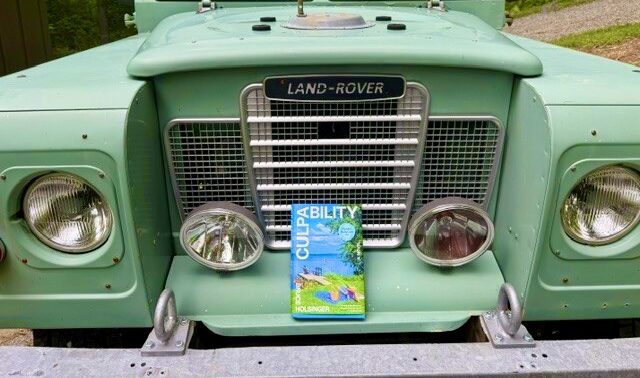
I’m in the market for a new car. When I say new, I actually mean somewhere between 2007-2015. Anything newer than that, according to my husband, and the electronics become problematic, prone to failure, expensive to replace. When cars rely on computers, of course, that takes away from the autonomy of the driver. Watch the road, check the rearview mirror, avoid distraction, check your tire pressure and oil levels. These are things we can control, learn, do. Most of us can’t fix sensors, chips, or diagnose algorithms. And with government mandated systems like automatic breaking and steering, at what point do you eliminate personal responsibility? What do we do in a world where accountability disappears?
In Bruce Holsinger’s novel, Culpability, Noah Cassidy, whose name should remind us of Noah and his ark, has to steer his family through the tumultuous waters of modern-day tech and legalities, as well as old school human emotions like jealousy, envy, and love. While Noah’s ark is designed to weather the flood of God’s anger and save mankind, Holsinger’s Noah doesn’t seem to have much of a grasp as captain of his familial “ship.”
This may be because his wife, Lorelei Cassidy, has a dual Ph.D. in engineering and philosophy with a focus on the ethics of Artificial Intelligence. If anyone should understand what is right and wrong, it is Lorelei. Yet, Lorelei’s name requires some attention as well; according to German folklore, she is a siren who lures sailors to their death with her song. She symbolizes both the allure and danger of love. Applying a 21st century ideology to her character, we have to wonder what Holsinger has in store. Is she the anti-siren, hoping to prevent disaster as AI takes over our world? Or is she somehow responsible for unwittingly causing disaster?
Early in the novel, Noah’s family of five is on a trip to his son’s lacrosse tournament, driving their state-of-the-art minivan, Sens Trek, made by IntelliGen, a car that basically drives itself. When Noah’s oldest daughter, Alice, (another name that takes us down a rabbit hole), yells at her brother, Charlie, who is driving, to “stop,” he grabs the steering wheel on impulse, and the van collides with an oncoming car, killing the elderly couple inside. To recuperate after the accident, the family rents a place on the Chesapeake Bay. It is here they hope to deal with the fact that Charlie may be held responsible for involuntary manslaughter and that his scholarship to play lacrosse at UNC Chapel Hill hangs in the balance. His younger sister, Izzy, suffers a broken leg, Lorelei must wear a neck brace, and Alice has a severe concussion. Only Noah and Charlie walk away physically unharmed.
What follows is largely from Noah’s perspective, though Lorelie and Alice’s voices also come through in two contradictory mediums: Lorelei’s book on the ethics of AI and a text chain that captures the conversation between Alice and her bot-friend, Blair. As secrets unravel, the characters believe they are in control of their own narrative. But this illusion quickly disappears when Charlie goes missing with his new girlfriend, Eurydice Monet (another foreboding allusion), the daughter of Daniel Monet, founder and CEO of a multinational tech firm. Daniel is currently one of the holdouts in the tech world who refuses to sign a statement that warns against the existential threats of AI, a threat Lorelei recognizes.
Holsinger poses not only a question of who is culpable, but also who decides that culpability, punishment, or possibility of atonement. By reminding us that we experience an ever-increasing dependency on technology, he also asks us, what does it mean to be human? What happens when we can no longer rely on ourselves to determine right from wrong, good from bad? These questions are at the heart of this important novel. For now, I’ll be happy with my 2015 model car, hoping it continues to get me to and from work and that someone like Lorelei is looking out for my best interests.