


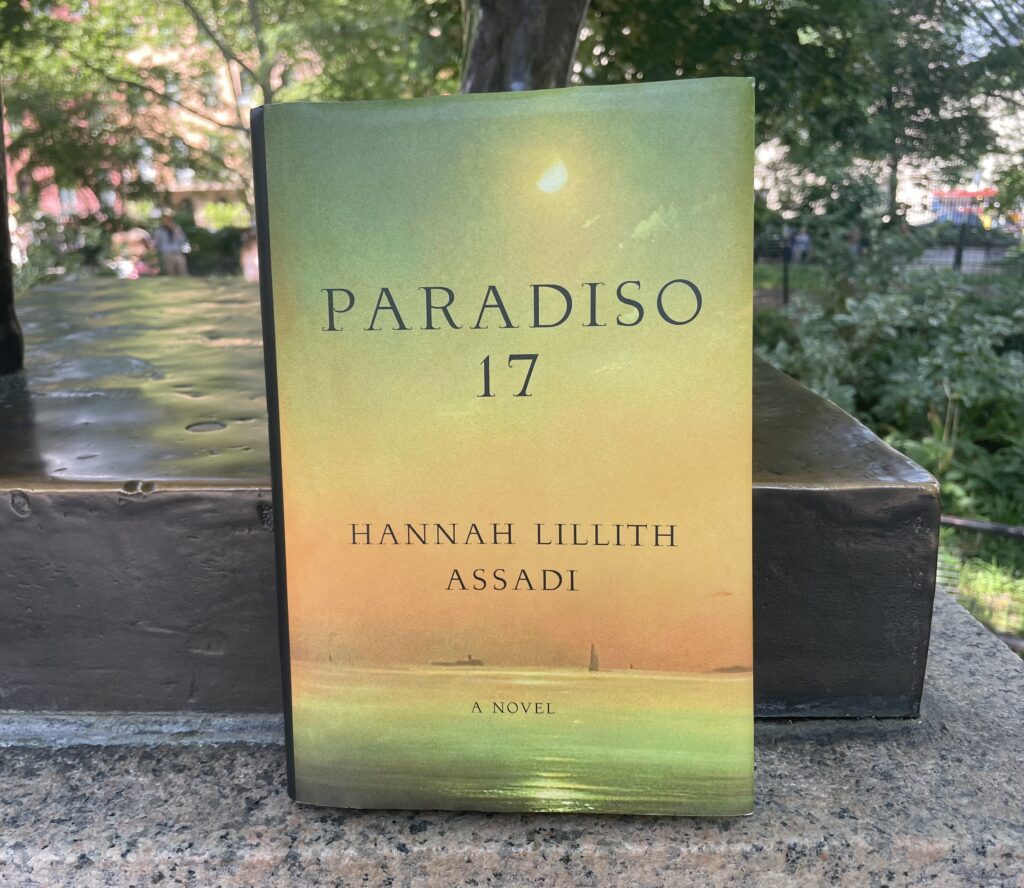
When I finally decided to pursue an M.F.A, I was fortunate to be in Hannah Lillith Assadi’s small fiction cohort. She was a kind and insightful teacher who helped me tremendously; she is also a talented author.
As in her past novels, Sonora and The Stars Are Not Yet Bells, Assadi’s newest work of fiction, Paradiso 17, mines the human condition with remarkable precision and poignancy. The sweeping yet intimate novel is a resonant portrait of exile and identity. It is also Assadi’s most personal work, inspired by the life of her late father, Sami Adbul Fattah Assadi.
Paradiso 17 begins in Palestine in 1948. Young Sufien, the oldest of an expanding brood, believes it is his fault that his family is forced to flee the only home they have ever known. At five years old, he does not yet comprehend the Nakba, the catastrophe that will uproot nearly one million Palestinians and reshape the rest of his days. Sufien will never return to the house in Safad with the blue door, but he will never forget.
Here is the decades-long arc of a man’s life, a life formed by his devastating legacy, a life of contradiction and imperfection. We follow Sufien on an extraordinary journey, first with his family to a bustling refugee camp in Kuwait, then to Syria. In his late teens, he travels alone to Italy to study engineering then on to America with his dearest friend, Bernardo.
Sufien drops of out of school, finds and loses jobs, endures loneliness and heartbreak, smokes and drinks too much, lives in squalid apartments, faces anti-Arab racism. But he perseveres, discovers joy and generosity, and, in his middle years, finds love with a Jewish woman.
The later and most moving chapters of Sufien’s life unfold in the deserts of Arizona, the beaches of Montauk, and eventually in the urban sprawl of New York, where he feels at peace driving a cab through the streets of his adopted city.
Assadi’s sensuous prose captures Sufien’s deep yearning for the Holy Land, the mystical setting that flows through his blood: “In that camp, he had witnessed the true beauty of the human soul, where it sings best, when trapped in the cul-de-sac of loss. He would look for this place, this time, for the rest of his life – he wanted its splendor from every party, but he would never quite find it again.”
The author asks us to bear witness to the choices her flawed protagonist makes, his kaleidoscopic emotions, and the forces beyond his control. There is no judgement, only immersive storytelling, poetic and compassionate, but not overly sentimental.
I cannot envision a timelier novel or one that more exquisitely portrays the physical and spiritual voyage of an ordinary man, displaced by war, haunted by the past, and searching for home. In Paradiso 17, we see the toll that human tragedy has taken on Sufien and, by extension, on an entire civilization.
In the book’s acknowledgements, Assadi writes, “To the people of Gaza, and greater Palestine, both those living in our homeland and those living outside of it, as well as those now dwelling beyond this life—especially my own tata and jiddo—I wrote this story against the backdrop of your unimaginable suffering, another Nakba, that Nakba ongoing. My soul is with you and is one with your struggle.”
Paradiso 17 is a magnificent gift to Palestinians and to all readers.